By Nobuko Japan Import Team | Updated: April 2026 | 100+ Irish imports handled since 2014
USS, TAA, JU Net Auction Access | MLIT Emissions Data Supplied | EU-Japan EPA Compliant
| Japanese auctions offer wholesale prices 20 to 40% below dealer retail, full condition disclosure through standardised auction sheets, and thousands of cars available daily through networks like USS, TAA, and JU Net.For a full comparison of full-service exporters, online marketplaces, and DIY auction access, see our guide to the best place to buy Japanese cars for export to Ireland. Japanese dealers offer fixed prices, retail-ready cars, sometimes short warranties, and a simpler buying process without learning auction grade codes. Choose auction if price is your priority and you are comfortable with as-is purchases. Choose dealer if you want simplicity and slightly more buyer protection. Both routes require official MLIT emissions documentation for Irish VRT calculation regardless of source. |
Japanese auctions are wholesale marketplaces where dealers and exporters bid on used cars before they ever reach a retail lot. USS, Japan's largest network, operates over 30 auction sites across the country and sells more than 30,000 cars per week. TAA (Toyota Auto Auction), JU Net, and ARAI are the other major networks, together covering the vast majority of used car transactions in Japan.
Cars are displayed on screens with a detailed auction sheet, bidding rises from a starting price, and the highest bidder wins. Every car sells as-is, with no returns and no warranty. Private buyers cannot bid directly. You need a licensed broker or exporter with auction membership,Choosing a trustworthy broker is critical at this stage. Our guide to verifying a Japanese car exporter covers exactly how to check auction access, fees, and reviews before you commit which is exactly the service a full-service importer like Nobuko Japan provides.
Japanese dealers operate retail lots similar to car dealerships in Ireland, selling directly to consumers including international buyers. Prices are fixed or lightly negotiable. Cars are often cleaned, serviced, and sometimes sold with a short warranty. Online platforms like BE FORWARD aggregate listings from dealer networks across Japan, letting you browse photos and descriptions before committing.
Many dealers are themselves buying from the same auctions, then adding a retail markup before reselling. The car you see at a dealer may have started its life at USS or TAA the same week. You are paying for the dealer's selection, cleaning, and the convenience of seeing photos rather than decoding an auction sheet yourself.
| Factor | Japanese Auction | Japanese Dealer |
| Price | Wholesale, 20 to 40% lower | Retail, includes markup |
| Condition disclosure | Full auction sheet with damage codes | Photos and basic description |
| Buying process | Competitive bidding | Fixed or negotiable price |
| Warranty | None, sold as-is | Sometimes, short term |
| Choice available | Thousands of cars daily | 50 to 200 cars per lot |
| Best for | Buyers comfortable reading grades | First-time buyers wanting simplicity |
Price is the main driver. A 2016 Toyota Voxy costs €4,000 to €5,000 at auction versus €6,000 to €7,500 from a dealer,This price gap is one of the main reasons Irish buyers choose Japanese imports over Irish dealer cars in the first place. See our full breakdown in why Irish buyers choose Japanese import cars. a saving of €2,000 to €2,500 on a single car. That gap exists because the dealer price already includes the markup they added after winning the same car at auction themselves.
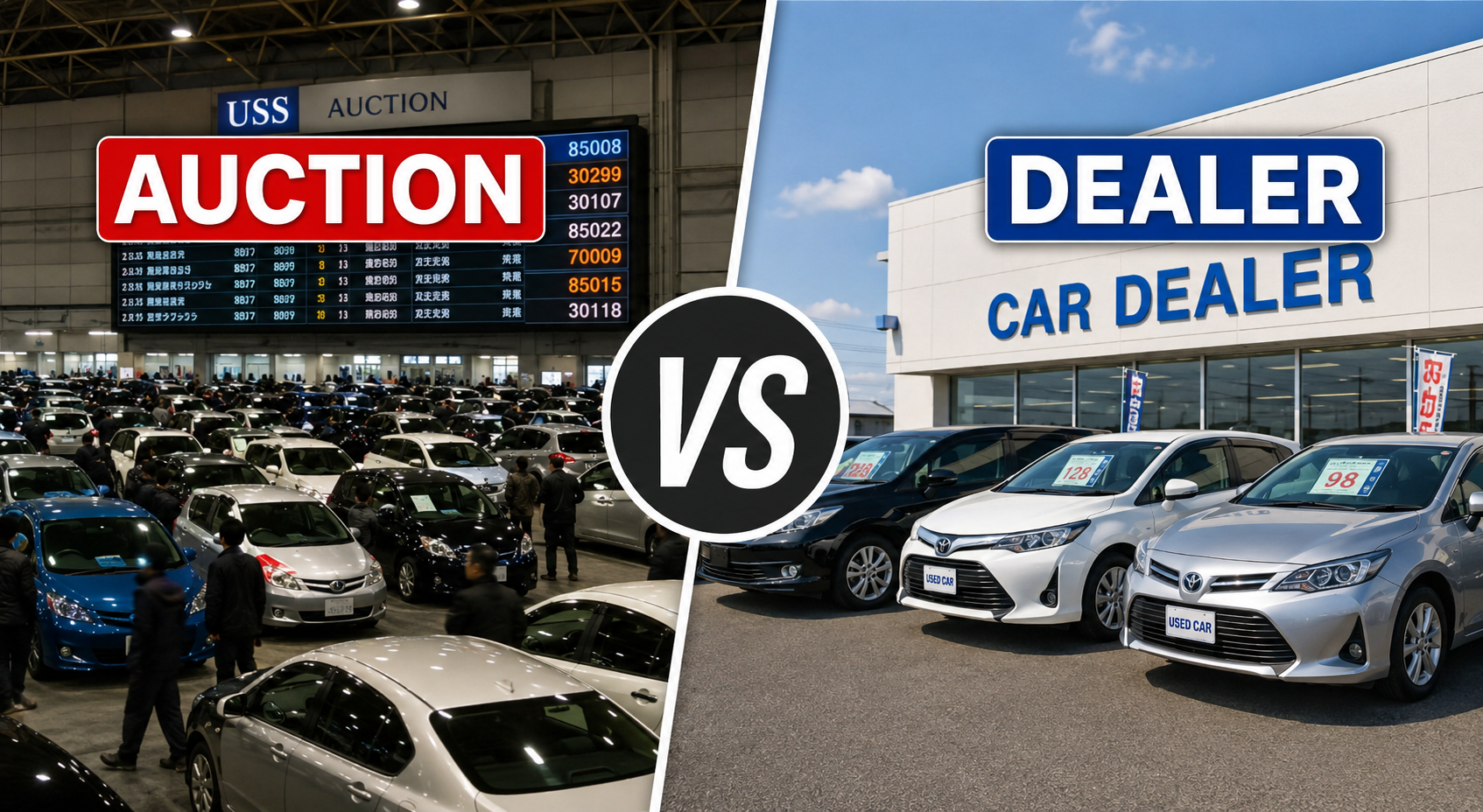
The second advantage is standardisation. Every auction sheet uses the same grading system regardless of which auction house sold the car. A dealer description saying good condition tells you nothing specific. An auction sheet showing Grade 4.5, interior B, with a 3cm scratch coded A1 on the driver door tells you exactly what you are buying before you commit. For a complete breakdown of every grade number, interior letter, and condition code used in Japanese auctions, read our Japanese auction sheet reading guide. Auction sheets also disclose repaired damage through the R grade, something a dealer description has no obligation to mention.
Auctions require bidding, which means uncertainty. You might lose the car to a higher bid, or you might win at a price higher than you planned. Dealers remove that uncertainty entirely. You see the price, you pay the price, and there is no competition to manage. For buyers who do not want to learn auction grade codes or manage a bidding strategy through an agent, this simplicity has real value.
Dealers also offer something auctions cannot: specific photo requests. You can ask a dealer for extra photos of the underbody, engine bay, or a specific panel before you commit. With an auction, you get what is on the standard sheet and whatever photos the auction house provides, typically four to six standard angles. For buyers who want extra visual reassurance on a higher value purchase, a dealer's flexibility matters.
If you choose the auction route, understanding grades is essential. The overall grade runs from 1 to 5, including half-point increments like 4.5. Grade 4 or 4.5 is the standard recommendation for Irish imports: good to excellent condition with only minor cosmetic marks. Grade 3.5 is the lowest grade worth considering, and only with a careful read of the full sheet. Grade 3 and below typically indicate condition issues Irish buyers should avoid.
The interior grade runs separately as a letter from A to D. Interior B or C is normal and acceptable for an imported car. Condition codes describe specific damage: A1 means a scratch under 10cm, U2 means a dent under 10cm, C indicates corrosion, and W indicates a welded or repaired panel. An R grade means the car has documented repair history. This is not automatically a reason to avoid the car, but it requires a closer look at exactly what was repaired before bidding.
Regardless of whether you buy at auction or from a dealer, Irish Revenue Commissioners calculate VRT on the OMSP, their estimate of Irish market value, not on your Japanese purchase price.For the full VRT formula and how OMSP is determined, see our complete VRT guide for Japanese imports in Ireland. What does change between routes is the documentation you need to provide. Every car, auction or dealer sourced, needs official CO2 and NOx emissions data from Japan's Ministry of Land, Infrastructure, Transport and Tourism (MLIT) to receive the correct VRT rate at the NCTS centre. Auction sheets do not include this data, so your exporter must obtain it separately regardless of source.
From 2026, both auction and dealer purchases of Japanese-manufactured cars qualify for 0% customs duty under the EU-Japan Economic Partnership Agreement, provided a valid Certificate of Origin accompanies the shipment. The purchase source does not affect duty eligibility. Manufacturing country does.
One Nobuko Japan customer wanted the lowest possible price on a 2015 Toyota Aqua. We bid on his behalf at USS Tokyo and won at €2,800. The auction sheet showed Grade 4.5, interior B, with a single noted scratch on the rear bumper. Total landed cost to Ireland came to €4,900, The Toyota Aqua is one of the best value hybrid imports for Ireland. See full landed cost breakdowns for similar budget models in our best budget Japanese cars to import to Ireland guide. against an Irish dealer price of €8,500 for the same model and year.
Another customer wanted a stress-free purchase and did not want to learn auction sheet codes. We sourced a 2016 Toyota Vitz through our dealer network instead. The dealer price was €4,500, roughly €1,300 above what the same car would have cost at auction, but it came with 40 photos, a 30-day warranty, and a pre-shipment service. Total landed cost was €7,200, still €2,300 below the Irish dealer equivalent.
The auction buyer told us: The sheet was detailed enough that I knew about the scratch before I paid. No surprises.
The dealer buyer told us: I paid a bit more but I did not have to learn grading codes. The video of the car running gave me confidence.
If saving the maximum amount matters more than convenience, and you are comfortable trusting a translated auction sheet over seeing the car yourself, auction is the right route. If you would rather pay a moderate premium for fixed pricing, extra photos, and a short warranty, a dealer purchase removes most of the uncertainty. Neither route is wrong. Nobuko Japan sources from both auction networks and vetted dealer partners and recommends the right fit based on your budget and comfort with as-is purchases.Once you have chosen your sourcing route, the next step is understanding the full import journey. Our step-by-step guide to importing a car from Japan to Ireland covers shipping, customs, and NCTS registration.
Choose auction for the lowest price, typically €2,000 to €3,000 less. Choose dealer for fixed pricing and simpler buying without auction grade codes.
A standardised condition report grading the car 1 to 5 with interior grades A to D, plus codes for specific damage. Grade 4 or 4.5 with interior B or C suits Irish imports.
Auction prices run 20 to 40% below dealer retail for the same model and year. A 2016 Toyota Voxy costs €4,000 to €5,000 at auction versus €6,000 to €7,500 from a dealer.
Yes, when the auction sheet is properly translated. USS, TAA, and JU Net sheets document every scratch and repair with standardised codes that remove most guesswork.
About This Guide
Written by the Nobuko Japan import team based on 100+ Irish imports handled since 2014, sourced from both auction and dealer networks. Auction data reflects real USS, TAA, and JU Net 2025 to 2026 records. VRT and OMSP references from Irish Revenue Commissioners at revenue.ie. MLIT emissions references from Japan Ministry of Land, Infrastructure, Transport and Tourism at mlit.go.jp. EU-Japan EPA duty rates from official EPA documentation. Last reviewed: April 2026.
For Latest updates
The Pakistani car market is constantly changing. In fact, sedan cars have been dominating the roads ...
Toyota Yaris Sedan is one of the major vehicles in the Toyota portfolio across the globe. This provi...
The Toyota Raize has gained popularity within the Pakistani roads since this mini-SUV resonates stro...
Considering the purchase of a new automobile in Pakistan? The traffic is heavy, the cost of gas is n...
Check out other articles related to Buying Guides.
Is the Toyota Raize the Perfect Small SUV for Pakistani Families?
