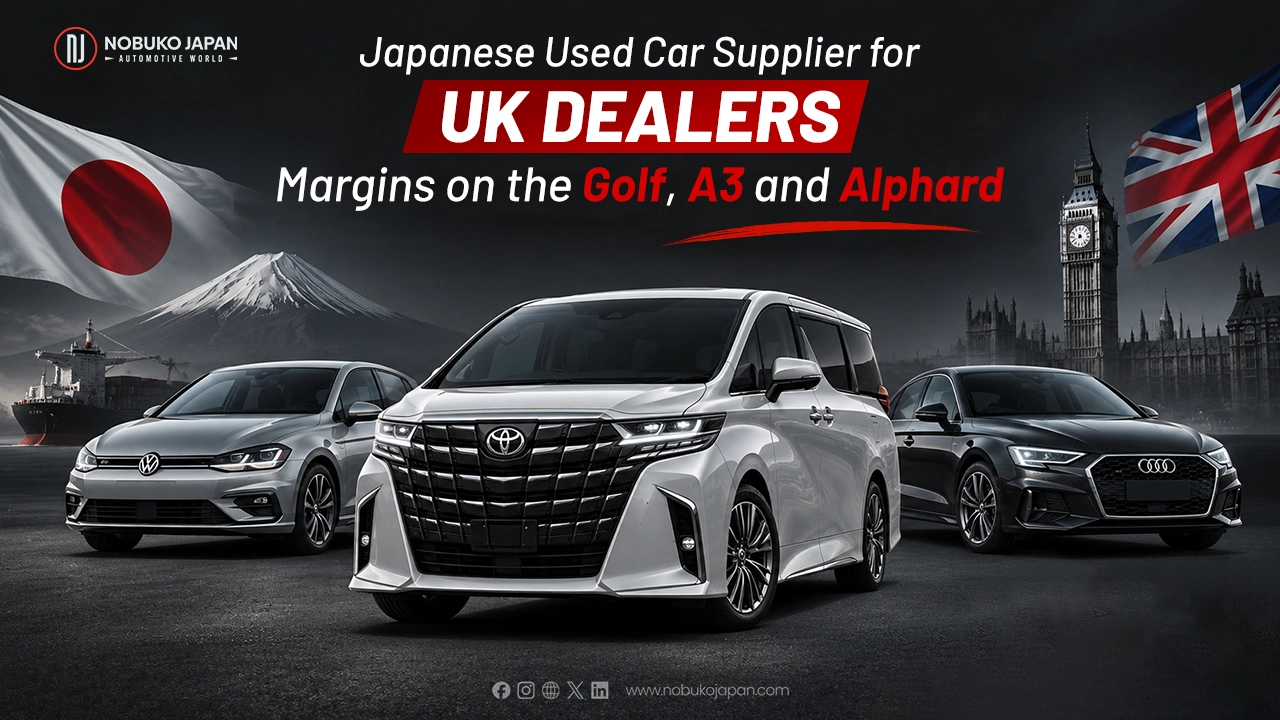
For UK dealers, Japan has become one of the best sources of low-mileage used stock. Cars there tend to cover fewer miles each year, come with an independent auction inspection, and are right-hand drive like UK cars. In 2026 the numbers improved further: under the UK-Japan Comprehensive Economic Partnership Agreement (CEPA), Japanese-built cars can now enter the UK at 0% import duty.
But the margin on a Japanese import depends on more than the auction price. Where the car was built, how old it is and what it needs to pass UK registration all change your landed cost. Our Vehicle Sourcing Team has handled more than 500 UK imports since 2014, and this guide explains how those factors play out on three models UK dealers ask us about most: the VW Golf, the Audi A3 and the Toyota Alphard.
Quick answer: Japanese-built cars like the Alphard can now enter the UK duty-free, which makes them the strongest margin play. European cars bought in Japan, like the Golf and A3, may still carry 10% duty, so they only work if you buy well. On any car under 10 years old, budget for an IVA test.
Work out margin on the full landed cost, not the auction price. For a car imported from Japan to the UK, that includes:
If you are VAT-registered, ask your accountant how import VAT interacts with the second-hand margin scheme before setting prices. It changes how much of the VAT you can recover. Our 2026 import cost breakdown covers each charge in more detail.
A car bought in Japan is not automatically Japanese-origin for duty purposes. The 0% CEPA rate applies to cars manufactured in Japan, and only when the supplier provides a statement on origin with the shipping documents. A Golf or A3 bought at a Japanese auction was built in Europe, so it does not qualify for the Japan rate. Unless your customs broker can confirm another preference applies, budget for 10% duty on European-built cars.
This is the biggest single difference between the three models below.
The Golf is one of the most common European cars in Japanese auctions, and Japanese examples often show much lower mileage than UK cars of the same age. That makes it easy to find stock. The challenge is margin: with likely 10% duty on top of 20% VAT, a Golf needs to be bought well below the UK retail price of a comparable low-mileage car.
Age is the key decision. A Golf over 10 years old avoids the IVA test, but sells for less. A younger Golf sells for more but needs IVA, including fitting a speedometer that shows mph. Set a clear maximum bid for each age band before the auction.
The A3 follows the same duty rules as the Golf, with a higher retail price that can absorb import costs more easily. Check the equipment before you bid: Japanese-market cars can have Japanese-language navigation and infotainment, which UK buyers may want replaced or updated. Factor that cost into your maximum bid, and use the auction sheet to confirm the trim and condition. Our auction sheet guide explains what to look for.
The Alphard is the strongest margin model of the three. It is built in Japan, so it can qualify for 0% duty under CEPA with a statement on origin. It is not part of Toyota's regular UK range, so used imports are the main source for UK buyers. Demand comes from large families, executive transport and chauffeur firms, and hybrid versions are especially popular.
Because the Alphard costs more, each car ties up more of your cash and the import VAT bill is larger. Check seating layout and condition carefully on the auction sheet. Higher-spec interiors are what UK buyers pay a premium for.
| Factor | VW Golf | Audi A3 | Toyota Alphard |
| Built in | Europe | Europe | Japan |
| Likely UK import duty | 10% | 10% | 0% with statement on origin |
| Import VAT | 20% | 20% | 20% |
| Supply in Japan | Plentiful | Good | Plentiful |
| UK buyer demand | Steady, price-sensitive | Steady, premium buyers | Strong, limited UK supply |
| Main margin risk | Duty plus tight retail pricing | Infotainment and trim costs | Higher cash outlay per car |
A good Japanese used car supplier for UK trade buyers should supply the statement on origin for Japanese-built cars, provide original auction sheets and chassis numbers, consolidate shipments, and understand NOVA and IVA requirements. For a full checklist, read how to choose a reliable Japanese car supplier, and for setting up regular orders, our trade buyer's guide.
For the full UK process, see our UK page, our step-by-step UK import guide and our pros and cons of Japanese imports in the UK.
Cars built in Japan can enter the UK at 0% duty under CEPA when the supplier provides a statement on origin. Without it, or for cars built elsewhere, 10% duty usually applies. Import VAT at 20% applies either way.
Cars under 10 years old imported from outside the EU need an IVA test before DVLA registration. Cars over 10 years old need only an MOT.
Japanese-built models with limited UK supply, such as the Toyota Alphard, usually offer the best margin because they qualify for 0% duty and face less local competition.
It depends on your VAT registration and whether you sell under the second-hand margin scheme. Check with your accountant before pricing stock.
Browse Japanese used cars for sale, follow live listings on our Japanese car auctions page, or request specific models for your forecourt. To discuss trade volumes, contact us through our contact page. You can read what other UK buyers say on our testimonials page.
Nobuko Japan Vehicle Sourcing Team
Our sourcing team has 14 years of experience in Japanese used vehicles, auction bidding and vehicle sourcing, and has handled more than 500 UK imports since 2014. The team buys at Japanese auctions and from leasing and rental sources every week, and supplies dealers and private buyers in the UK, Ireland, Cyprus, Pakistan and the USA. This guide reflects the questions UK trade buyers ask us most often about cost and margin.
Last reviewed: October 2026.
For Latest updates

The Japanese car auction market is continuously evolving with time. They offer buyers worldwide acce...

Japanese brands are the smart choice when you need a reliable car. In fact, companies like Toyota an...

Cost Breakdown of Importing a VehicleThinking about importing a car? Then you're at the right place....
.webp)
Why the Toyota Alphard is Gaining Popularity in the UKThe Toyota Alphard car has literally taken the...
Check out other articles related to Market trend.

